
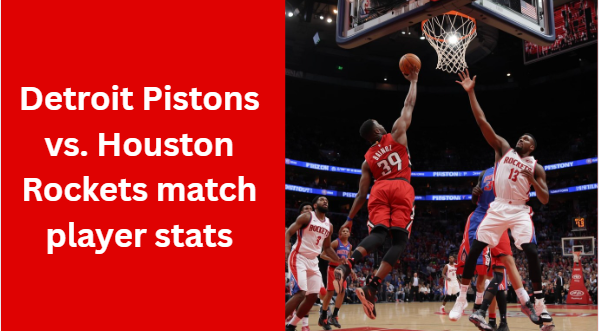
When the Detroit Pistons face the Houston Rockets Match Player stats fans aren’t just watching a basketball game—they’re watching the future of the NBA take shape. Both franchises are rebuilding around young cores, and every matchup offers a snapshot of development, confidence, and progress. That’s why interest in Detroit Pistons vs. Houston Rockets match player stats continues to grow among fans, analysts, and fantasy basketball players.
This article breaks down how individual players influence the game through scoring, playmaking, defense, and hustle—all reflected clearly in the stat sheet.
Matchup Context: Detroit Pistons vs. Houston Rockets match player stats
The Detroit Pistons vs. Houston Rockets match player stats Pistons and Rockets often meet as teams searching for consistency but showing flashes of brilliance. These games are typically fast-paced, physical, and unpredictable. Instead of veteran control, the spotlight falls on young players eager to prove they belong in the league.
Detroit Pistons vs. Houston Rockets match player stats from these games often show improvement rather than perfection—which makes them fascinating to analyze.
also ready Houston Rockets vs. Detroit Pistons match player stats
Detroit Pistons vs. Houston Rockets match player stats Breakdown
Scoring and Offensive Output
Detroit Pistons vs. Houston Rockets match player stats offense focuses on attacking inside and creating high-percentage shots. Player scoring stats usually show:
- Points: Team leaders often score between 17 and 26 points.
- Field Goal Efficiency: Higher success near the rim
- Free Throws Made: Aggressive drives lead to frequent trips to the line.
Rather than relying heavily on three-point shooting, the Detroit Pistons vs. Houston Rockets match player stats use physicality to generate offense.
Assists and Ball Distribution
Playmaking is a key development area for Detroit Pistons vs. Houston Rockets match player stats often include:
- Assists: Guards average 5–7 assists per game
- Potential Assists: Showing improving court vision
- Turnovers: A common issue due to youth and experimentation
Games with higher assist totals usually result in stronger Pistons performances.
Defensive and Hustle Detroit Pistons vs. Houston Rockets match player stats
Defense is where Detroit often makes its biggest impact. Important stats include:
- Rebounds: Dominance on the defensive glass
- Blocks: Protecting the rim against drives
- Steals: Pressuring Houston’s ball handlers
These stats help Detroit stay competitive even during scoring droughts.
Detroit Pistons vs. Houston Rockets match player stats Player Stats Breakdown
Scoring Style and Efficiency
The Detroit Pistons vs. Houston Rockets match player stats prefer speed, spacing, and perimeter shooting. Match player stats often highlight:
- Three-Point Attempts: High volume from guards and wings
- Transition Points: Scoring off turnovers and rebounds
- Balanced Scoring: Multiple players in double figures
Houston’s offensive stats reflect freedom and confidence in shot selection.
Playmaking and Offensive Flow
Houston encourages ball movement as part of its rebuild. Key stats include:
- Assists: Team totals reflect pass-first basketball
- Secondary Playmaking: Multiple players contributing assists
- Turnover Rate: A tradeoff for playing at a fast pace
Defensive Activity
Defensively, the Rockets rely on athleticism. Detroit Pistons vs. Houston Rockets match player stats often show:
- Steals: Quick guards disrupting passing lanes
- Defensive Rebounds: Triggering fast breaks
- Blocks: Rim protection from young big men
These defensive plays often lead directly to scoring opportunities.
Head-to-Head Detroit Pistons vs. Houston Rockets match player stats
Detroit Pistons vs. Houston Rockets match player stats ofter
Comparison
When reviewing the Detroit Pistons vs. Houston Rockets match player stats, several trends usually stand out:
- Pistons often lead in rebounds and points in the paint.
- Rockets usually dominate three-point shooting and fast-break scoring.
- Assist totals are often close due to shared development focus
- Turnovers frequently decide momentum swings.
These statistical differences reflect contrasting offensive philosophies.
Key Game Moments Seen in Detroit Pistons vs. Houston Rockets match player stats
Detroit Pistons vs. Houston Rockets match player stats often reveal the turning points of the game. Fourth-quarter points, clutch rebounds, and defensive stops show:
- Which young player handled pressure best?
- How bench production influenced momentum
- Why one team closed the game more effectively
In close games, even a single steal or offensive rebound can change the outcome.
Why Detroit Pistons vs. Houston Rockets match player stats Matter for These Teams
For rebuilding franchises, Detroit Pistons vs. Houston Rockets match player stats are more than numbers—they’re progress indicators. These matchups help evaluate:
- Growth in shot selection and efficiency
- Defensive consistency and effort
- Emerging leadership roles
Fans watching player stats gain insight into which players are forming the foundation of future success.
FAQs
- Why are Pistons vs. Rockets player stats closely analyzed?
Because both teams focus on development, individual performances matter more than final scores.
- Which team usually shoots more three-pointers?
The Detroit Pistons vs. Houston Rockets match player stats generally attempt more shots from beyond the arc.
- Who tends to win the rebounding battle?
The Detroit Pistons vs. Houston Rockets match player stats often have the edge due to their physical interior play.
- Do turnovers impact these games heavily?
Yes, turnovers frequently lead to fast-break points and momentum shifts.
- Where can fans track official match player stats?
Official NBA websites, team apps, and live broadcasts provide real-time Pistons vs. Rockets stats.
Final Thoughts
The Detroit Pistons vs. Houston Rockets match player stats tell a story of effort, learning, and potential. These games may not always be polished, but they are packed with intensity and opportunity. Each matchup reveals which players are growing, adapting, and preparing to lead their teams forward.